The marksheet is one page.
Your child is a whole book.

What happens beyond the classroom here is not "extra" curricular — it is essential curriculum. Sports, arts and life skills carry the same seriousness, the same expert coaching, and the same place in the timetable as mathematics and language.

Marks matter. So do character, confidence, empathy and courage.

What actually changes

The traditional model.
And ours.

A simple side-by-side of the approach many of us grew up with and the one we have chosen — and every line on the right is something you can watch happening on a campus visit.

A typical school
Jain Heritage School
The child adapts to how the class is taught
The teaching adapts to how the child learns — and it is written down
Progress means a rank against the class
Progress means this month against last month, for that child
Life skills get a weekly period
Competences are built inside maths, language and science — or not at all
Labs, and a library, and a rank list
A Manipulative Learning Centre and a Contemplative Learning Centre, in use
Sport and arts are what's left after academics
Sport, art and music are timetable, because five potentials are being measured
A campus tour on a rehearsed open day
Come on an ordinary Tuesday morning and watch a normal lesson
Coverage at pace
Time given to actually learn — there's no hurry

"Not everything from Finland applies here. We adopt the best practices that work for our students and fit within the board framework."

— Jain Heritage School, Electronic City · Institutional Framework
What that looks like on a timetable

Six things we build
on purpose.

Each of these appears as a tile on the home page. Here is what actually sits behind each one — and, where it belongs to a stage, where to go and read how it is taught.

Children exploring hands-on materials
Discovery Zone

A room that answers
"what happens if…"

The Discovery Zone is where a question gets tested instead of answered. Children observe, wonder and explore with real materials — water, seeds, shadows, our street — and the week's phenomenon is investigated rather than described.

It is the first step of the learning path used across the school: wonder, then experience, then collaborate, then reflect, then apply.

How the learning path works

A microscope set up in the school science lab
STEAM & Robotics

Hands-on studios where
science meets imagination

Science, technology, engineering, arts and mathematics taught as one thing rather than five. Concepts come alive through hands-on projects rather than through a diagram copied off a board.

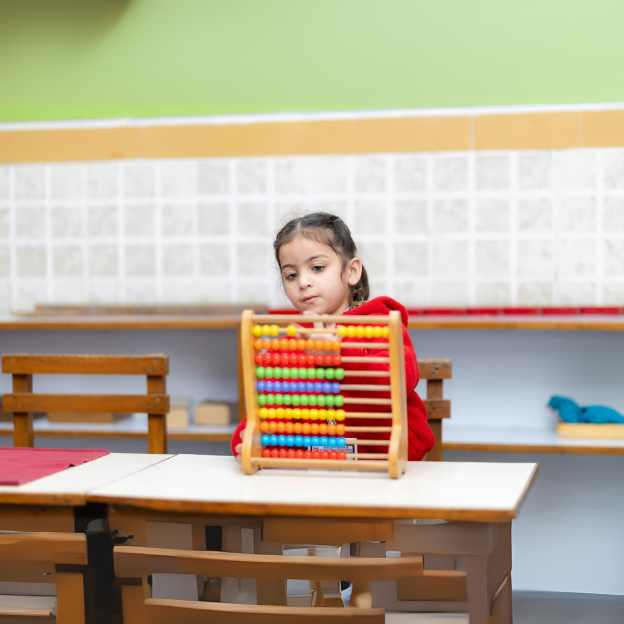
Alongside the labs sits the Manipulative Learning Centre — a room built around the idea that children think with their hands. Fractions you can hold, volume you discover by pouring, area you build.

See the learning centres

Children playing outdoors
Sports education

Open, safe play areas
and expert coaching

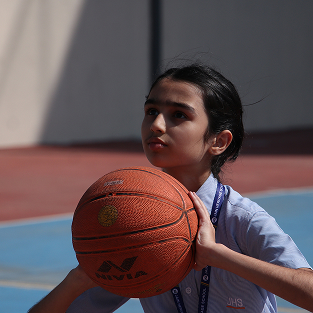
Fitness and teamwork, coached properly. Gross and fine motor development is planned, sequenced and tracked — not left to the playground to sort out — and outdoor learning happens in most weather, with wet days planned for rather than cancelled.

Bodily-kinesthetic ability is one of the eight intelligences we deliberately develop. A child who cannot sit still is not a discipline problem; very often they are a kinesthetic learner in a visual classroom.

Students working together on a project
Budding Entrepreneur Programme

Initiative, taught as
a subject you can practise

Working life skills and enterprise is one of the seven transversal competences in the Finnish framework — and it is the point where a JAIN school and Finland want exactly the same thing. Planning, budgeting, and seeing an idea through to something real.

The group it belongs to was built on a college founded in 1990. Enterprise is not an elective in this institution's history.

Read the Chairman's message

A teacher working alongside young children
Cross-disciplinary academics

One real thing,
investigated properly

Instead of studying water in science, then again in geography, then writing about it in English, children investigate water — where ours comes from, what it costs, what happens when it runs out — and pull in whatever subjects the question genuinely needs.

Every child takes part in at least one multidisciplinary module each year, sometimes working with several teachers at once. It sounds loose. It is the opposite: it only works on a very well-structured curriculum.

See it in Grades 1–7

A student reading and working at her desk
Library, reading and reflection

A warm corner, and
a quiet room

A reading space that nurtures a lifelong love of books, and next to it the Contemplative Learning Centre — a quiet room for reflection and metacognition, which is to say thinking about your own thinking.

Nearly every school in Electronic City has laboratories. A room designed for reflection is rare, and it is not decoration — it is where independent learning is actually taught.

See the campus spaces

Not one-size-fits-all

Intelligence isn't
a single test score.

A child who cannot sit still isn't necessarily a discipline problem — they may be a kinesthetic learner stuck in a visual classroom. We identify how a child actually learns, across all eight recognised intelligences, before we decide how to teach them — and we write it down, so the next teacher does not start from zero.

Visual

Learns through images, diagrams and demonstration.

  • Infographics and diagrams
  • Video and visual explanation
  • Colour-coded structure

Auditory

Learns through listening, discussion and saying it aloud.

  • Structured discussion
  • Oral explanation and retelling
  • Audio and read-aloud

Kinesthetic

Learns through movement and doing it with their hands.

  • Experiments and building
  • Field trips
  • Hands-on projects

Alongside those three routes, all eight multiple intelligences are deliberately developed: linguistic, logical-mathematical, spatial, bodily-kinesthetic, musical, interpersonal, intrapersonal and naturalistic.

Have a question you'd rather just ask?

Call our admissions team on +91 96630 21118 — Monday to Saturday. Or leave your details and we will call you back at a time that suits you.

Enquire Now
See it in practice

Two ways in.
One continuum.

See exactly how each stage is taught, day by day — then tell us which one fits your child.

Answered openly

The questions
worth asking.

These are the questions we would want answered if we were choosing a school for our own children — so here are ours, in full.

Is "Finnish" just a label on the gate?

Fair question, and the honest answer is that you should not take our word for it. Come and look. What you should be able to see on a campus visit: teachers trained in Finnish teaching practices, children mid-activity rather than seated in rows, the Manipulative and Contemplative Learning Centres in use, daily mindfulness, and assessment recorded as observation and portfolio rather than as a rank. If you cannot see those things, the label means nothing — at any school.

All of this sounds lovely. Does it come at the cost of academics?

No, and the reason is more interesting than a reassurance. Both boards are moving the same way: CBSE is shifting from memorisation to competency-based assessment under NEP 2020, and ICSE has always rewarded internal assessment, project work and reasoning over recall. Finnish pedagogy's whole emphasis is understanding and critical thinking. We are not deviating from either board — we are ahead of where both are already going. The board-by-board detail is on the CBSE page and the ICSE page.

What is the class size and adult-to-child ratio?

Personalised attention is structurally impossible at high ratios, so this is a fair thing to press us on. Our stated staff–student ratio is 1:15. On your visit we will give you the current figure for the specific class your child would join, which is more useful than an average.

Are the labs, sports facilities and studios actually there?

Yes — the campus is open. On your visit we will show you the labs, sports facilities and studios as they are running today, and tell you plainly if any specific space is still being finished.

My child is quiet, or slow to settle, or not a natural performer. Where do they fit?

They are the reason the approach exists. Because we identify how a child learns rather than how fast, a child who needs more time receives targeted support. Finland has among the lowest achievement gaps in the world, and that is not an accident of talent — it is a consequence of method.

What are the fees?

We share the full structure — tuition, meals, supplies, transport by distance, and the discounts and concessions available — during your campus visit, so you get the complete picture rather than a headline number. Please disregard fee figures listed on third-party school-aggregator websites; several are years out of date.

Enquiries open · Playgroup to Grade 7, growing to Grade 12

Come and watch
a Tuesday morning.

Not an open day. An ordinary morning, with the children doing what they ordinarily do. It is the only school visit worth taking — and the only proof that actually settles the question.

Sy No 22/2 & 25/2, Rayasandra Main Rd,
Rayasandra, Bengaluru, Karnataka 560099

📞 +91 96630 21118

Book your visit

Two minutes. A counsellor calls you back to confirm a slot.

Your details go to our admissions team and nowhere else. We do not sell or share them.